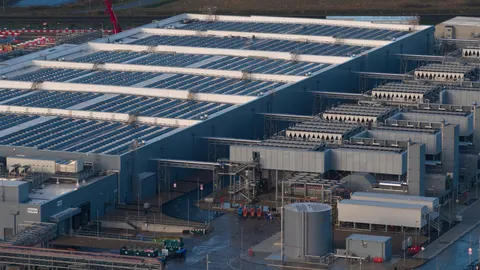
A warning drawn from Britain’s infrastructure challenges argues that the US must expand its AI data centre capacity while protecting households from higher energy costs and ensuring technology companies bear the financial risks.
The debate over artificial intelligence data centres in the United States is becoming increasingly contentious. Concerns about noise, electricity prices, environmental impact and the influence of major technology companies have prompted calls for tighter restrictions on new developments.
However, critics of a construction freeze argue that refusing to expand domestic data centre capacity could carry significant economic and strategic consequences for the country.
The central argument is that America should continue building the infrastructure needed to support artificial intelligence, while introducing safeguards to protect consumers and taxpayers.
The United Kingdom offers a cautionary example, according to the opinion piece. Its author argues that years of restrictive planning policies and infrastructure delays have made major developments more expensive and difficult to deliver.
What Britain’s Infrastructure Challenges Reveal
The article compares Britain’s approach to development with the fictional Shire from J.R.R. Tolkien’s The Lord of the Rings — a peaceful landscape that residents seek to preserve.
It argues that prioritising local environmental concerns and protecting existing landscapes can come at a broader economic cost when essential infrastructure projects are repeatedly delayed.
One example cited is the Lower Thames Crossing, where planning and approval processes reportedly generated hundreds of thousands of pages of documentation and substantial pre-construction expenses.
The article also highlights the additional costs associated with environmental requirements, including measures introduced to protect wildlife during infrastructure development.
According to the author, these examples illustrate how complicated approval processes can increase project costs, discourage investment and weaken industrial competitiveness.
The broader argument is that infrastructure restrictions may protect local environments in the short term while making it harder for countries to maintain economic growth and improve living standards over time.
Why a US Data Centre Freeze Could Be Risky
Turning to the United States, the article argues that restricting data centre construction would not necessarily slow global AI development.
Instead, investment and technological development could shift towards other regions, including China and the Gulf countries.
Such a shift, the author warns, could weaken America’s position in a strategically important industry, increase dependence on foreign technology infrastructure and create additional cybersecurity and national security concerns.
The argument reflects the growing importance of artificial intelligence across business, defence and critical infrastructure.
The article also references President Donald Trump’s position that leadership in AI will have major implications for global economic and technological influence.
Electricity Costs and Infrastructure Must Be Addressed
Despite supporting further data centre construction, the author acknowledges that the expansion of AI infrastructure presents significant challenges for the US electricity system.
Large data centres require substantial and reliable power supplies. If new facilities depend too heavily on existing electricity networks, households and other businesses could face higher costs.
The proposed solution is to require technology companies to secure dedicated power sources rather than relying entirely on the public grid.
Potential options include gas-fired generation, restarting nuclear facilities and establishing dedicated power connections.
The article argues that consumers should not be expected to finance electricity infrastructure upgrades primarily intended to serve major technology companies.
Concerns Over AI Financing and Corporate Accountability
The opinion piece also raises questions about financial arrangements within the AI industry, particularly what it describes as circular funding.
Some technology and semiconductor companies are involved in financing arrangements that support businesses purchasing their products. The author argues that such relationships deserve scrutiny to ensure that financial risks are properly understood.
The central concern is that if the AI investment boom slows or turns into a downturn, shareholders and private investors — rather than taxpayers — should bear the losses.
The article frames this as a matter of corporate accountability, arguing that large technology companies should not receive public financial protection while ordinary businesses and households carry the risks.
Balancing AI Growth With Long-Term Risks
The debate extends beyond infrastructure and electricity costs. Concerns about job displacement, the long-term safety of advanced AI systems and the possibility of wider economic disruption remain central to discussions about the technology.
The author acknowledges these risks but argues that unilateral restrictions on American AI development would be difficult to justify without enforceable international agreements governing the technology.
In this view, the United States must continue investing in AI capabilities while developing policies that address energy demand, financial transparency, cybersecurity and public safety.
The Strategic Importance of Staying Ahead
The article concludes with a reference to Tolkien’s fictional Shire, arguing that its peaceful existence depended on protection provided by people beyond its borders.
The comparison is used to suggest that national security and technological strength can help preserve the stability and prosperity enjoyed by ordinary citizens.
For the United States, the argument is that maintaining a competitive AI industry requires investment in the infrastructure behind it.
The challenge, however, is ensuring that expansion does not come at the expense of households, taxpayers or long-term environmental and economic interests.
This article presents the argument of an opinion piece, not an established consensus. Claims about the UK’s infrastructure costs, the effects of planning restrictions and the national security consequences of limiting US data centre construction should be independently checked before publication.
Post Views: 1